
Running an ABA practice means juggling clinical data, insurance claims, and session schedules, often across multiple clinicians and payers at the same time. Fragmented tools make that harder. The best all-in-one ABA software for billing, data, and scheduling puts those functions on a single platform, cuts the administrative drag, and keeps clinicians focused on client outcomes rather than paperwork.
All-in-one ABA software has to handle billing, scheduling, and data at the same time
Most ABA practices don’t fail clinically. They lose ground when billing can’t keep pace with session data, when scheduling changes never reach payroll, or when supervisors are making decisions from reports that are already a week stale. A true all-in-one platform stitches these functions together so that a session completed in the field updates the same record a BCBA pulls up the next morning.
The five platforms below were selected because each covers billing, data collection, and scheduling without requiring a separate tool to fill the gaps. Pricing, team fit, and depth of clinical features vary, but all five are built for ABA or behavioral health practices operating under the medical insurance model.
5 Best ABA Billing Software: Quick Comparison
Note: All data in this table is sourced from review platforms and the official websites of the listed companies.
| Company Name | Best For |
| Theralytics | Clinical practices scaling with data integrity priorities |
| Rethink Behavioral Health | ABA and pediatric therapy providers |
| ABA Matrix | ABA therapy practices and behavioral health clinics |
| Raven Health | ABA therapy providers and behavioral health clinics |
1. Theralytics
What Problem Does Theralytics Solve?
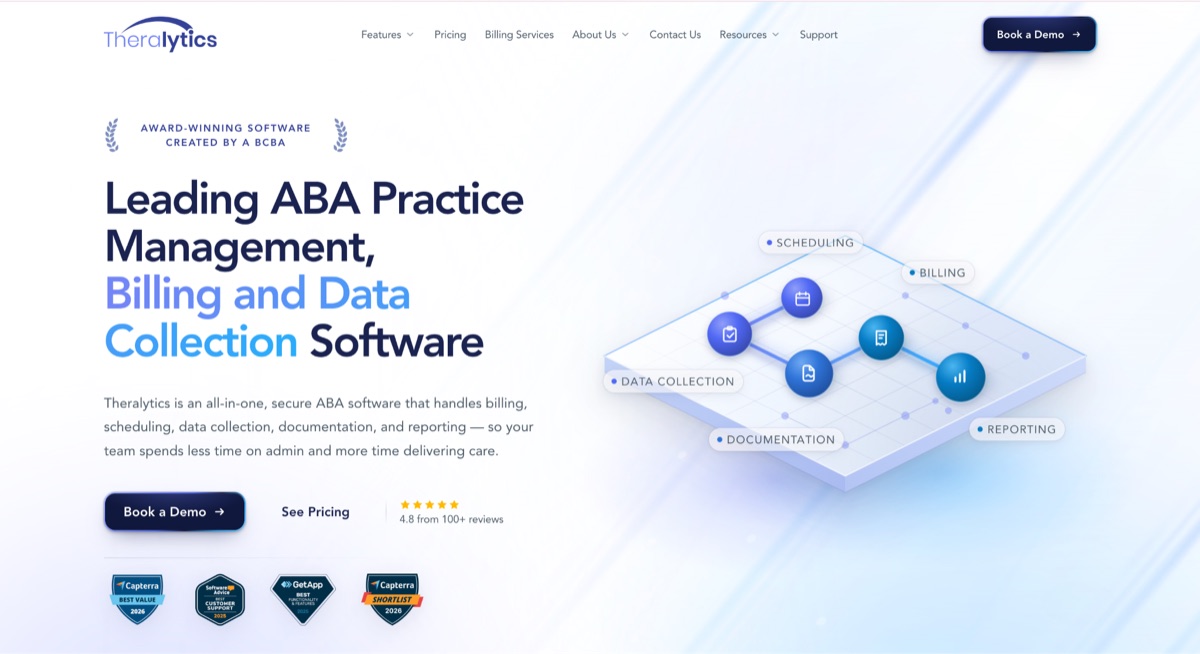
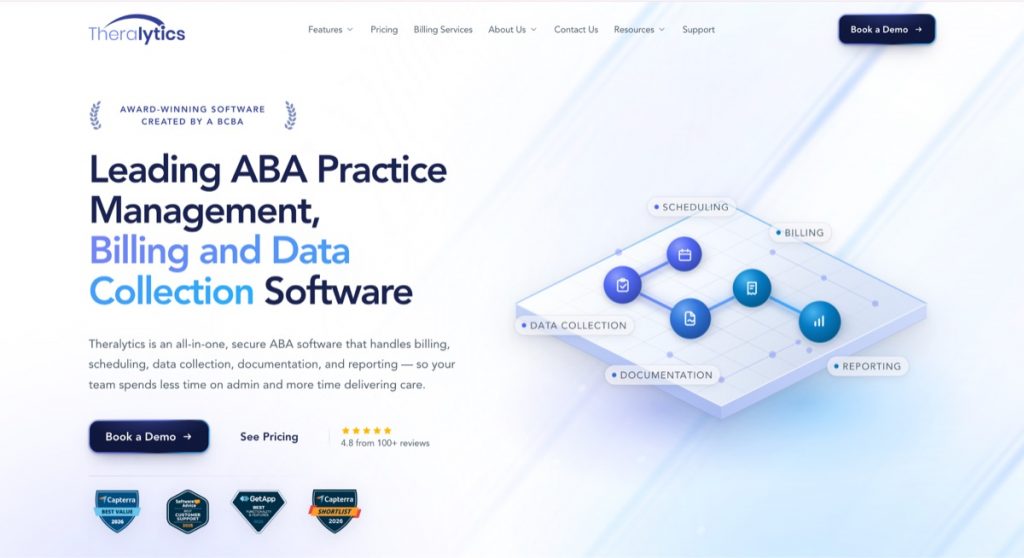
Theralytics, software for ABA practices, addresses the separation between clinical data and administrative operations that can create unnecessary duplication in ABA practices. The platform brings scheduling, billing, parent portals, and session-level data collection into one system, with real-time synchronization between clinical and operational information. Automated graphing and progress monitoring reduce manual documentation and give BCBAs and supervisors access to current treatment data without relying on disconnected tools.
What’s Theralytics’ Edge in Top ABA Practice Management Platforms?
Theralytics connects clinical and administrative workflows within a single platform, helping practices reduce redundant documentation and maintain consistent information across scheduling, billing, and data collection. The platform uses AES-256 encryption and maintains SOC 2 Type II certification covering data at rest and in motion, supporting the security of clinical and operational data.
The Review Roundup:
Feedback highlights the connection between clinical and administrative workflows as a key feature of Theralytics. The platform provides a centralized environment for ABA data collection, scheduling, billing, and progress monitoring, while third-party integrations may require custom API work.
2. Rethink Behavioral Health
What Problem Does Rethink Behavioral Health Solve?
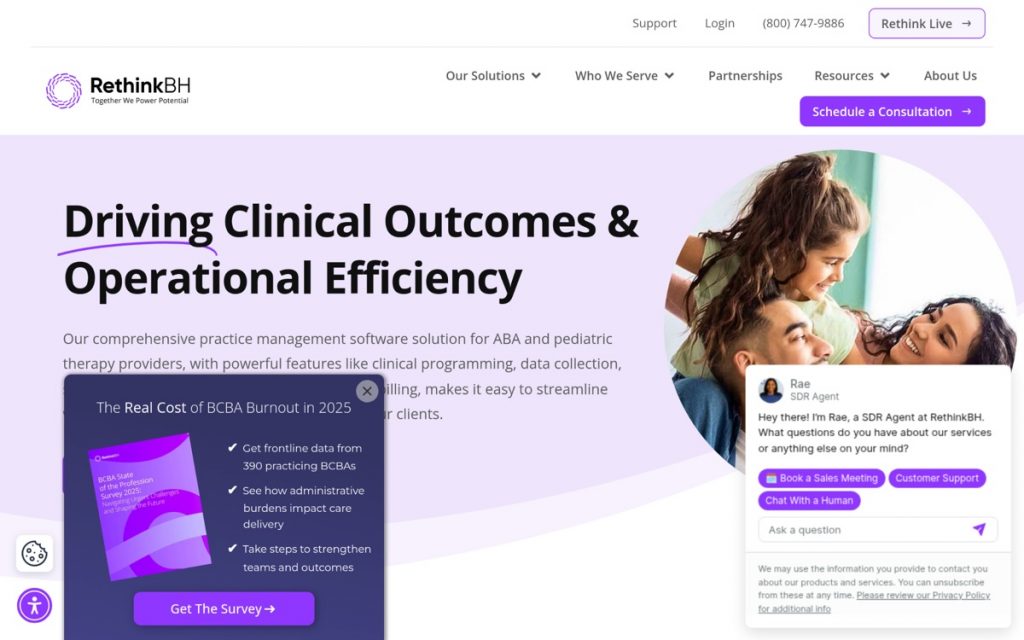
Rethink Behavioral Health has been at this since 2007, which gives them a depth of ABA-specific feature development that newer platforms are still building toward. Their content library holds over 1,500 customizable care plans, which is a meaningful asset for practices that don’t want to build treatment documentation from scratch. The Medical Necessity Assessment tool stands out on its own, with an 87% average clinician agreement rate across over 500 ABA organizations. That tool directly addresses one of the biggest billing pressure points in ABA: justifying clinical necessity to payers clearly and consistently.
What’s Rethink Behavioral Health’s Edge in Top ABA Practice Management Platforms?
Rethink Behavioral Health addresses the clinical documentation and medical necessity challenge that causes the most authorization friction for ABA practices billing under the medical insurance model. With over 2,000 customers worldwide and a platform built by clinicians for clinicians, the depth of ABA-specific thinking in the product shows in features that actually match real workflow needs.
The Review Roundup:
Detailed public reviews are limited, but the scale of adoption across 2,000-plus customers and the 87% clinician agreement rate on the Medical Necessity Assessment tool are strong indicators of real-world confidence. That kind of clinician validation usually means the platform earns trust through practical usability, not just feature lists.
3. ABA Matrix
What Competencies Help ABA Matrix Grow?
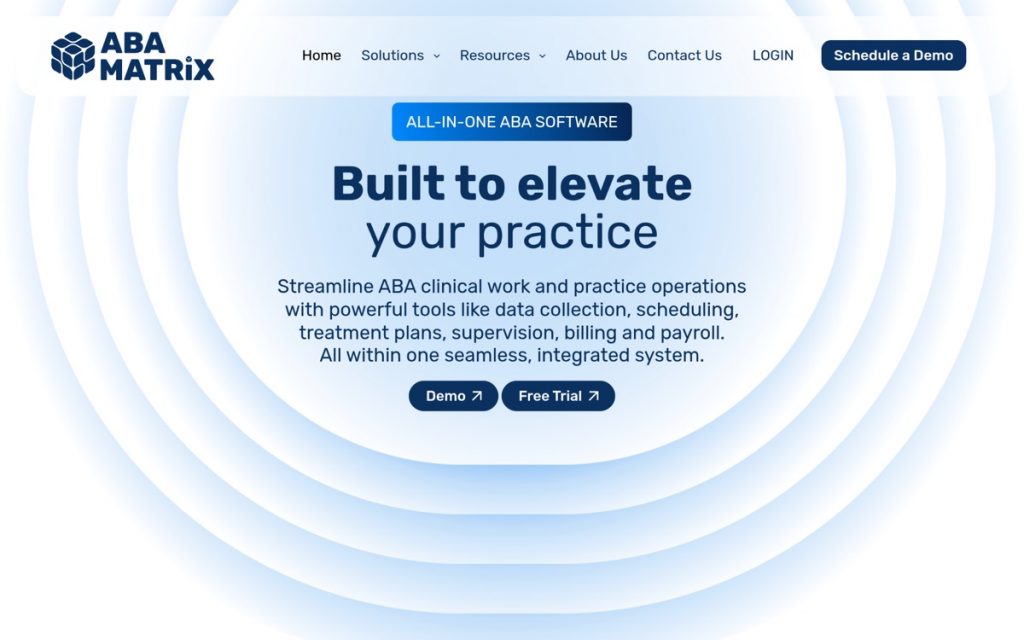
ABA Matrix takes an all-in-one approach without the enterprise-level pricing that usually comes with it. Their platform covers data collection, scheduling, billing, progress notes, assessments, graphing, reporting, compliance alerts, and payroll in one place. The unit-based pricing model is a real differentiator (not cheap at the high end, but genuinely fair for smaller practices). Running as an independent, bootstrapped company means they’re not chasing investor timelines, which tends to translate into steadier product development focused on what clinicians actually need.
What Makes ABA Matrix Stand Out for ABA Data Collection Software?
ABA Matrix handles the challenge of finding a platform that serves a solo practitioner just as well as a large private practice, without forcing either one into a pricing tier that doesn’t fit. That kind of scalability is rare in a space where most tools are built for one size of operation.
The Review Roundup:
ABA Matrix was named the Top ABA Therapy Data Collection and Practice Management Platform 2026 by Healthcare Tech Outlook Magazine, which adds real credibility to the user praise. Case studies point to improvements in assessment accuracy and day-to-day operational flow. For practices that need compliance coverage without paying enterprise prices, this one comes up consistently.
4. Raven Health
What Competencies Help Raven Health Grow?
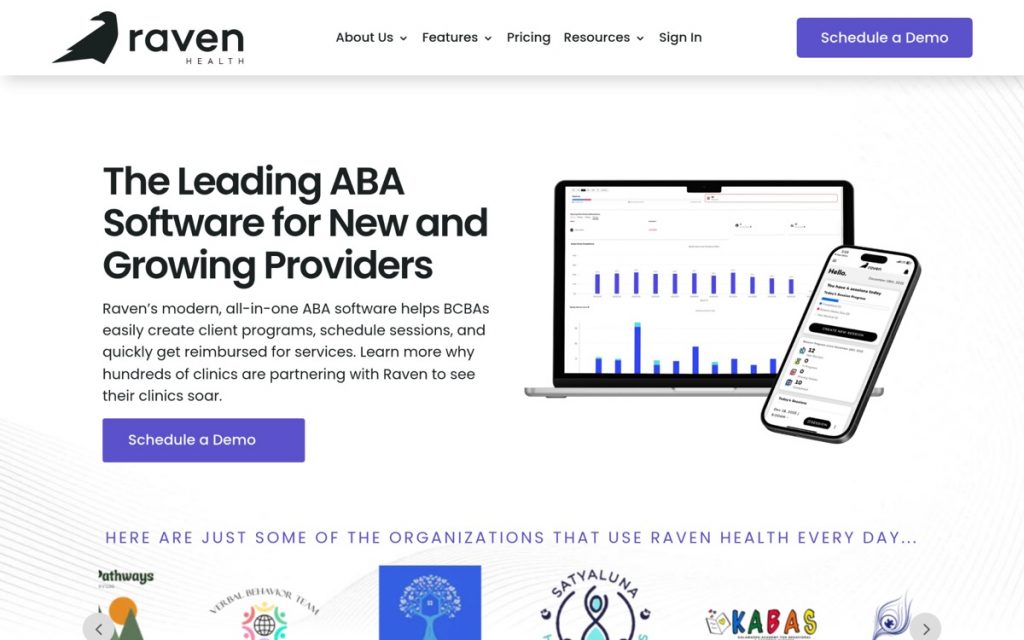
Founded in 2020, Raven Health has moved quickly to build a platform that clinicians actually want to use. Their design philosophy starts with healthcare provider requirements, not technology assumptions, and the result is an interface most users pick up in under 15 minutes (which matters a lot when you’re training new RBTs). The platform supports offline data collection, which solves a real problem for providers working in home or community settings without reliable internet. Their Managed Billing Bundle charges only a percentage of collected claims, so the revenue model works with client success.
What Makes Raven Health Stand Out for ABA Data Collection Software?
Raven Health tackles the steep learning curve that typically slows software adoption in ABA clinics by building mobile-first and keeping the interface genuinely intuitive for frontline staff. That design choice has a direct effect on how consistently RBTs complete session notes on time.
The Review Roundup:
Client implementations like Crescent Bloom and Pair Tree Autism Services give a real-world picture of what the platform delivers operationally. The mobile-first approach and fast staff training come up repeatedly as reasons practices choose Raven over older platforms. That kind of practical usability is hard to fake when the reviews are this consistent.
5. TherapyPMS
Which Industries Does TherapyPMS Serve?
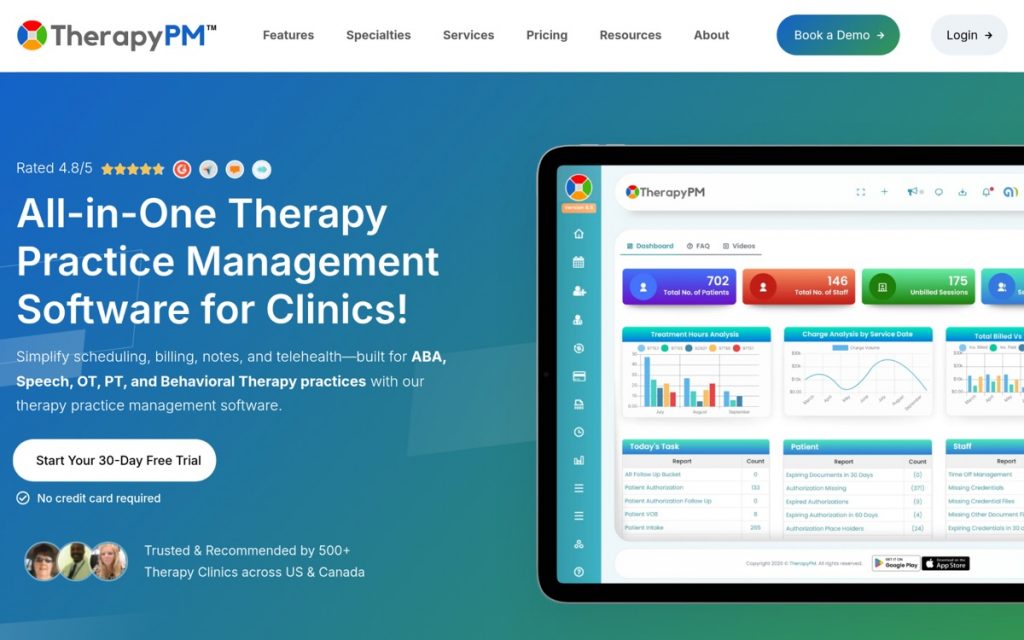
TherapyPMS covers a broader therapy slice than most platforms on this list, including ABA, occupational therapy, speech therapy, mental health, pediatric therapy, and physical therapy. They’re trusted by over 500 clinics across the US and Canada, which signals real market validation. The platform ties credentialing, billing, and telehealth tools together in a single system built for therapy workflows (not adapted from a general medical billing product), and it meets SOC-2, HIPAA, and GDPR standards.
Why Is TherapyPMS a Contender for Top ABA Billing Software?
TherapyPMS directly targets the revenue cycle problem by offering accounts receivable services with a reported 99% reimbursement success rate, which matters for practices watching their collection rate as a percentage of billed charges. Their multi-specialty design means practices that offer ABA alongside other therapy services don’t need separate billing systems for each one.
The Review Roundup:
User testimonials point to strong adoption across clinic sizes, with administrators particularly satisfied with how the platform handles billing without requiring deep coding knowledge. Cash flow improvements get mentioned most often. That kind of consistent feedback across 500-plus clinics is hard to argue with.
What separates real all-in-one platforms from point solutions
A platform that covers billing and data collection separately, but doesn’t connect them, isn’t truly all-in-one. The defining feature of the best all-in-one ABA software for billing, data, and scheduling is that a session completed in the field automatically informs the billing record and updates the clinical graph. That connection matters.
Four capabilities signal a genuinely unified system:
- Real-time data sync between clinicians and supervisors, so BCBAs aren’t reviewing yesterday’s numbers
- Session-to-claim linkage that pulls documentation directly into the billing workflow, cutting manual re-entry
- Offline data collection with automatic sync for in-home and community-based service settings
- Scheduling that connects to payroll and billing, so a rescheduled session updates every downstream record
Point solutions handle one or two of these well. A real all-in-one handles all four, and the difference shows up in claim denial rates, staff hours spent on admin, and how quickly supervisors can respond to a clinical trend.
Bottom Line
No single platform fits every ABA practice. A billing-heavy clinic that needs deep accounts receivable support will weigh TherapyPMS very differently than a solo BCBA who just wants clean data collection and straightforward scheduling. Three factors deserve top priority: whether billing and data are genuinely integrated rather than merely sitting side-by-side in a dashboard, whether RBTs can navigate the interface without lengthy training, and whether the pricing structure actually matches the practice’s client volume and where it’s headed. Start with a demo that walks through all three functions back to back. If the workflow cracks between modules, the platform isn’t as all-in-one as it claims.