

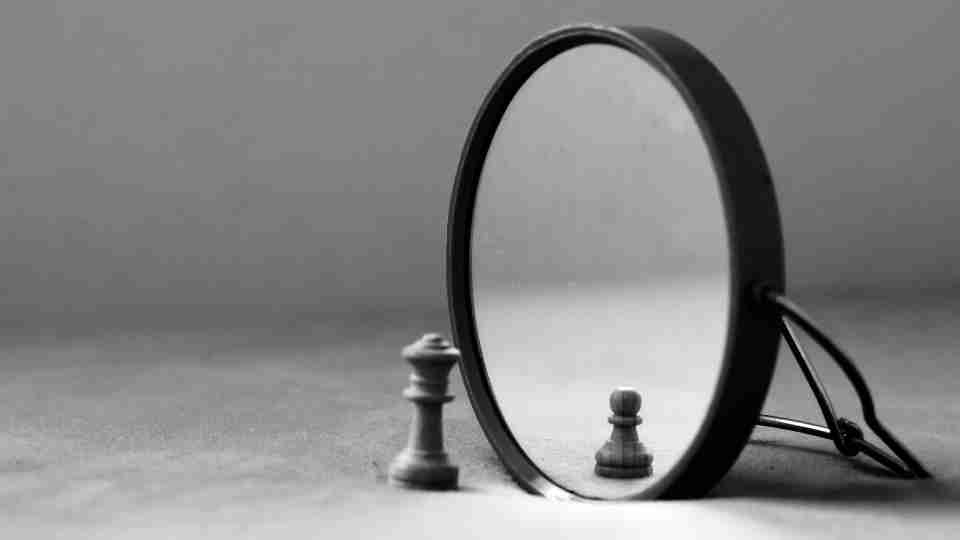
Each one of us has our own perception. This perception becomes our reality. But, the real reality is different and it’s above any perception. In this battle between perception vs reality, reality often has an upper hand.
We hardly see the world as it is. Mostly, we see the world through a set of layers. These layers are made up of our emotions, past experiences, and beliefs. But, this biased view of ours is actually detrimental to us in the long run. It doesn’t help us in any way.
Perception is how we see the world.
Reality is how the world is.
Perception vs Reality: Quick Answer
Quick answer: Perception is the meaning your mind makes of what your senses take in — shaped by your emotions, memories, beliefs and expectations. Reality is the way things actually are, whether or not anyone perceives them. The two overlap most of the time, but when they drift apart we make poor decisions, misjudge people and worry about things that aren’t happening. A good example of perception vs reality: you think a friend is angry because they replied to your message with one word, when in reality they were just busy.
| Perception | Reality | |
|---|---|---|
| Meaning | How an individual sees and interprets something | How something actually is |
| Source | Senses + the brain’s interpretation | Exists independently of the observer |
| Varies by person? | Yes — no two people perceive exactly alike | No — it is the same for everyone |
| Influenced by | Emotions, past experience, culture, expectations, biases | Facts and evidence |
| Can it change? | Yes, with new information or a new point of view | Only when the situation itself changes |
| Example | “My boss hates my work.” | Your boss gave two pieces of feedback on one report. |
Perception vs Reality Infographic
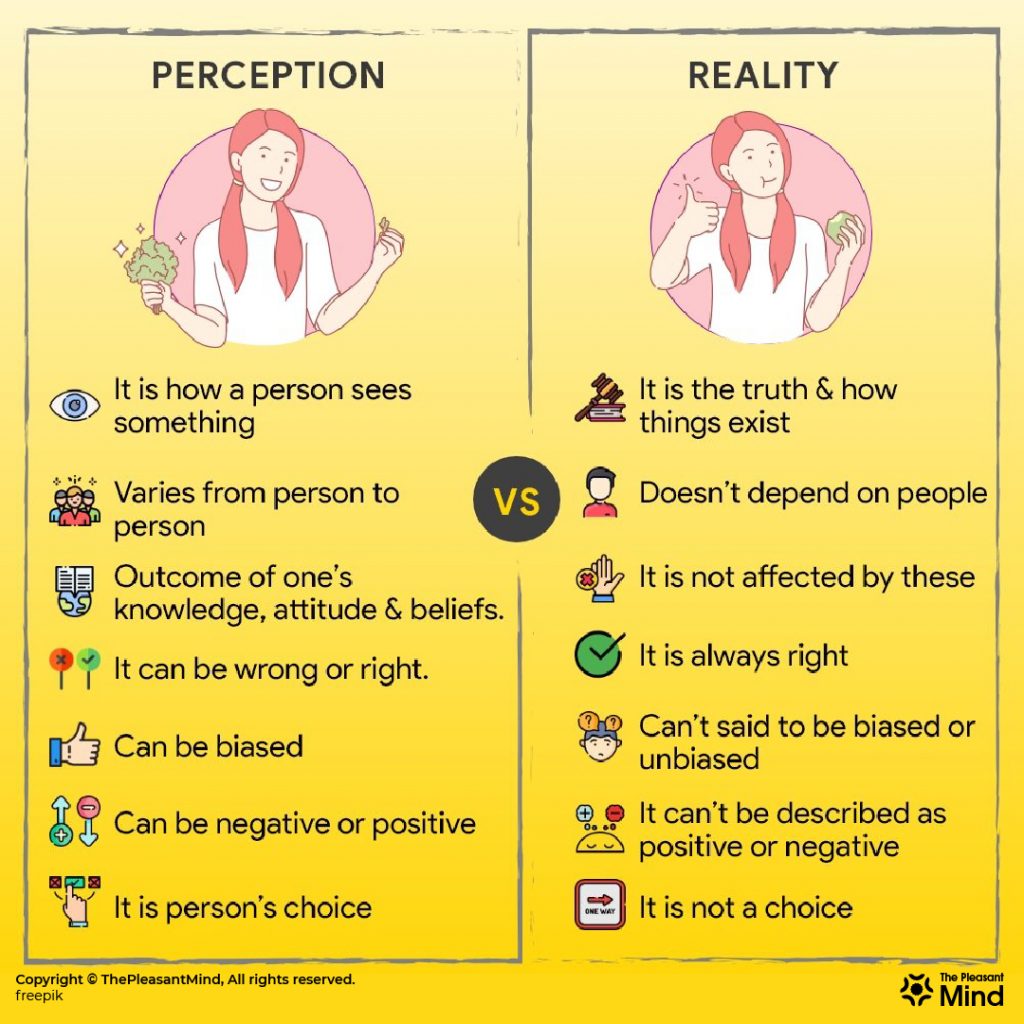
What is Perception?
In the simplest terms, perception is how an individual perceives reality. It is how he/she perceives the world.
Perception differs from person to person. It is an individual phenomenon and as such, no two perceptions are the same. Life perception is as unique as an individual and is as unique as the experiences an individual has.
It is the processing of reality by an individual. Perception is not reality. It rarely is.
That’s the case as perception is the final state of reality after it gets influenced by many factors. These factors are:
- Emotions
- Past experiences
- Knowledge
- And cognitive distortions of an individual
Even if our perception is not the reality it has great importance. So much so that it can determine if a person will lead an unhappy or happy life.
Perception Meaning in Psychology
In psychology, perception is the process of organising and interpreting sensory information so that it makes sense. It happens in two directions at once. Bottom-up processing starts with the raw data from your eyes, ears, skin, nose and tongue. Top-down processing uses what you already know and expect to fill in gaps and decide what that data means. Because top-down processing relies on your own experience, two people can receive the same information and perceive it differently.
What is Reality?
There are many philosophers around the world who will tell you there is no reality. There is only perception. You see, they describe reality as a collection of everyone’s perceptions. Again, whichever perception is held by most, is popularly deemed as the reality.
We are not going to go by philosophy here. For us, ‘reality’ is what the name suggests. It is REALITY!
Reality is the truth.
Reality is the actual state of things.
Reality is the opposite of all things imaginary.
Reality is the opposite of all things non-existent.
Reality is how things actually are before our emotions and preconceived notions have a chance to corrupt them.
The absolute nature of truth gets destroyed in the battle between perception vs reality. These concepts of perception vs reality give birth to three types of truth.
1) The truth which is actually the truth
2) The truth that you think is the truth
3) And the truth that is considered to be the truth by another person
In the above-mentioned points, only the 1st option is the truth and hence is the reality. While the 2nd and 3rd options are two perceptions of the same truth (reality).
10 Examples of Perception in Real Life
Perception examples are everywhere once you start looking. Some come from how our senses and brain work (the classic examples of perception in psychology); others come from how we interpret people and situations in everyday life.
- The Müller-Lyer illusion: Two lines of exactly the same length look different when one has arrow-heads pointing in and the other has them pointing out. Even after you measure them, most people still see them as unequal.
- Reading misspelled words: You can usually read a sentence full of typos without slowing down, because your brain predicts the word from context and fills in what it expects to see.
- Colour constancy: A white shirt looks white to you in daylight, under a yellow lamp and in the shade, even though the light reaching your eyes is very different in each case. Your brain adjusts for the lighting.
- “The dress”: In 2015, a photo of a dress split the internet: some people saw it as blue and black, others as white and gold. The dress itself was blue and black — people’s brains made different assumptions about the lighting in the photo.
- Hearing your name in a noisy room: At a busy party you can tune out dozens of conversations yet instantly notice when someone says your name. Your perception filters what matters to you.
- Judging a stranger by first impressions: Someone who doesn’t smile in a meeting may be perceived as rude or cold, when in reality they are nervous, tired or simply concentrating.
- Time flying or dragging: An hour with friends feels like ten minutes; ten minutes in a waiting room feels like an hour. The clock hasn’t changed — your perception of time has.
- Taste and expectation: Food often tastes better when it is beautifully presented or described as a treat. What you expect shapes what you experience.
- Social media comparison: Scrolling through other people’s highlights can create the perception that everyone else is happier or more successful, while the reality behind those posts is far more ordinary.
- Feeling unprepared before an exam or interview: Anxiety can make you perceive that you know nothing, even when your actual preparation is solid. This is the opposite of John’s story below.
Perception vs Reality Examples
Let’s try to understand the difference between perception and reality. Plus, why it is important for us to know the difference between them with the following example.
John is an 8th grader who has 1 month left to prepare for his final exams. He has been studying for 2 hours every day and feels confident that he will pass all his papers.
Being confident in his preparations he starts to study only 1 hour each day in the final month. After the exam was over and the results came out John was shocked. His report card stated that he had failed in two subjects.
John couldn’t understand how this could have happened as he had studied regularly.
You see when John studied for 2 hours every day he perceived he was well prepared. Also, he thought 2 hours/day was enough to prepare each subject.
He took his perception as the truth (the reality). But, it was obviously not the reality as it became clear after his results were out.
This situation could have been easily avoided if he had just taken a mock test on each subject. A mock test would have shown him what reality really was.
Here, John’s perception was that he was well-prepared. But, he was underprepared in reality.
From the above example, we can conclude that it is important for us to know the difference between perception and reality. This is because a wrong perception creates a false picture and can lead us to the wrong path.
Continuing on the wrong path for a long will deter us from achieving our goals. Also, in certain cases, our wrong perceptions may cost us. This may make it impossible for us to return to the desired track.
Perception vs Reality – Deviation of Perception from Reality
Yes, perception differs from reality as it gets a tint of human emotions and experiences. Minor deviations are also expected but extreme deviations will lead to catastrophic results.
It is desirable if our perception remains as close to reality as possible. Perception’s extreme deviation from reality will result in a highly skewed outlook of the world.
This, in no circumstances, leads to favorable outcomes. Deviation of perception from reality can lead to two different scenarios:
1st scenario: A deviated perception yields a positive impact on the person.
One positive effect of a deviated perception is an inflated view of self. In other words, it can give an overestimation of one’s capabilities.
At most, this wrong perception can give a person hope and improved endurance for the time being.
But, this positive effect will soon come to an end in the moment of truth. Since the positive effect of the wrong perception is highly transient.
2nd scenario: Where this deviation can cause a negative impact.
Mostly, a deviated perception inclines more towards the negative side of things. For example, we may always worry that something bad is going to happen in the future.
This may stem from our perception that the present circumstances are bad. This may lead to low self-esteem and give birth to anxiety and depression.
A deviation of our perception from reality is never good. It becomes a greater liability if our illusion converts into delusion. When someone loses touch with reality altogether (for example, through hallucinations or fixed false beliefs), it can be a sign of psychosis, which needs professional help.
Is Perception Reality?
You will often hear the phrase “perception is reality”, especially in business and politics. It doesn’t mean that what you believe magically becomes true. It means that people act on what they perceive, so their perception has real consequences. If customers perceive a brand as unreliable, they stop buying from it — even if the product is excellent.
So the honest answer is: perception is not reality, but it is your reality until you check it. Your perceived reality guides your feelings, choices and relationships. That is exactly why it is worth testing your perceptions against facts, feedback and other points of view.
How to Bring Your Perception Closer to Reality
- Separate facts from stories. Write down what actually happened, then what you concluded about it. The gap between the two is your perception at work.
- Look for evidence against your view. Ask, “What else could explain this?”
- Ask for feedback. A trusted friend, colleague or mentor can show you what you can’t see from the inside.
- Measure where you can. Mock tests, budgets, trackers and data reveal reality more reliably than gut feeling.
- Notice your mood. Stress, tiredness and anxiety tint perception. Avoid big judgements when you are running on empty.
Perception vs Reality: How to Differentiate
It is not easy to differentiate between perception and reality. If it were easy people would always be on the right side of things. They would have always taken the right decisions.
But as we can all admit, we have been wrong, multiple times in our lives. It was not until later, that we realized that we were wrong.
Most of the time, we are not even aware that we are wrong. This is the main limitation of perceiving the world through our senses.
Our perception has this inherent quality of misguiding us. Moreover, since perception stems within us it is not easy to tell that we are wrong. This continues until some external source forces us to see the reality.
So what’s the solution? How do we come to know that this is my perception and this is the reality?
Recall the example that we gave of John. John was only able to understand that his perception didn’t match the reality when his results were out. In this case, it was his report card that showed him the truth.
Here report card can be said to be that external source that showed him what the reality was. John’s result was an instrument of measuring reality.
It’s the instrument of reality that can differentiate between our perception and reality. Only this instrument can help us tell what the truth is.
Quiz or revision tests could have served as an instrument of measuring reality as well. This would have been a better way of finding out for John that he was wrong.
In our lives, the opinion of a friend, colleague, family, or others can help us distinguish between perception and reality.
The Importance of Positive Perception
Yes, we all perceive situations and events differently. But broadly speaking, our perceptions can be classified into two main categories.
1) Negative Perception
2) Positive Perception
While perception is not the reality it still has great significance in our lives. The way we see the world and the way we see the situation affect us. For one, it affects our outlook on the world. It affects what we feel about others.
Perception also greatly impacts our level of happiness in life. A negative perception leads to low satisfaction and low enthusiasm towards life; whereas a positive perception can even convert a tragic situation into a cause for inspiration.
Psychologists have found that the way we interpret events is not fixed. With practice — for example, the cognitive reframing used in cognitive behavioural therapy — we can learn to notice a negative interpretation and choose a more balanced one.
Let’s see the benefits of having a positive perception
- Positive perception promotes happiness
- It reduces stress in life
- Gives people hope
- Makes people more patient in difficult situations
- Instills confidence
- Improves our relationships
Perception vs Reality FAQs
What is the meaning of perception?
Perception is the process by which your brain selects, organises and interprets information from your senses to make sense of the world. It is shaped by your experiences, emotions, beliefs and expectations.
What is an example of perception?
A simple example of perception is seeing two equal lines as different lengths in the Müller-Lyer illusion. An everyday example is assuming a friend is upset because of a short text, when they were simply busy.
What is the difference between perception and reality?
Perception is how you see and interpret something; reality is how it actually is. Perception is personal and can change, while reality is the same regardless of who is looking.
Is perception reality?
No, but it can feel like it. People act on what they perceive, so perceptions have real effects on behaviour, relationships and decisions. That is why “perception is reality” is a popular saying.
What is perceived reality?
Perceived reality is the version of the world that exists in your mind — the facts as filtered through your senses, memories and beliefs. Everyone has their own perceived reality.
Final Thoughts
Understanding perception vs reality is essential for us as human beings. Our daily life decisions are based on the understanding of the two.
When we are able to separate our own perception from reality we can take the necessary measures to be happy. Plus, we can be on the right path to achieve our goals.
Article Sources
1. https://www.differencebetween.com/difference-between-perception-and-vs-reality/
2. https://www.psychologytoday.com/us/blog/the-power-prime/201908/perception-is-not-reality
3. https://www.imsts.com/perception-vs-reality
Sometimes, we happen to fall prey to false beliefs, distorted thoughts, and incorrect perceptions that we are great, or extraordinary in some way. Want to know why? Do read our article on Delusions of Grandeur!
